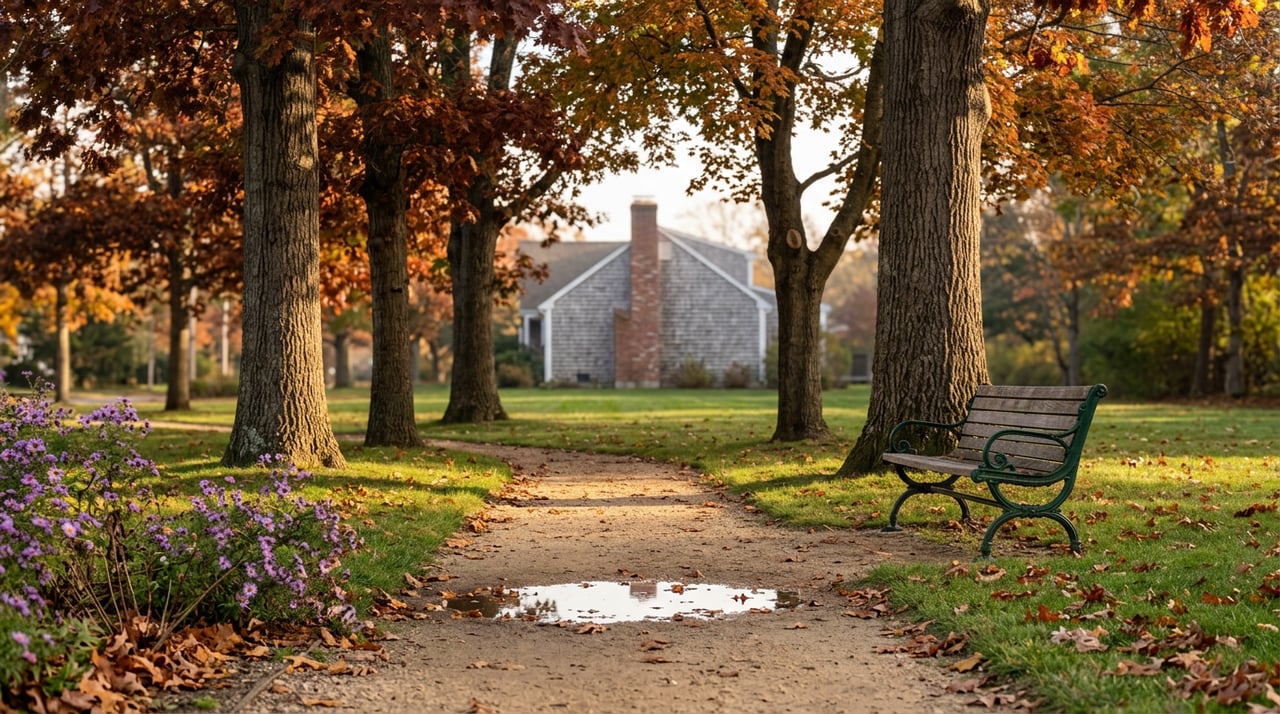
Walk Blackstone Boulevard on the last Saturday of October and you will see something that does not happen on Freeman Parkway or Olney Street or any of the East Side's other well-decorated blocks: kids arriving on purpose from somewhere else. Families from Mount Hope make the trip regularly. So do people from well outside the neighborhood.
The usual explanation is the architecture. Big Victorians, dressed-up porches, candy in bulk. That explains why individual streets look festive. It does not explain why one median strip pulls foot traffic from across the city while blocks with equally grand houses a few streets over stay quiet. The real answer has nothing to do with Halloween at all. It has to do with a cemetery.
A road built for the dead, borrowed by the living
Blackstone Boulevard was not designed as a neighborhood amenity. It was built in 1894 to give Providence better access to Swan Point Cemetery, and that single fact explains almost everything about how the corridor behaves today. A funeral road needed to be wide, direct, and comfortable for slow-moving processions, so the city built a median 100 feet across, flanked by two separate roadways that each carry a bike lane and a travel lane. The boulevard runs 1.6 miles and is listed on the National Register of Historic Places, a designation most residential East Side streets do not carry.
That width is the whole story. Most East Side sidewalks are narrow, tree-root-buckled, and pressed close to traffic. Blackstone Boulevard is a park that happens to have houses on either side of it. Cars are pushed to the outer edges. Foot traffic gets a buffer no other street in the neighborhood offers, which is exactly what you want on a night when a few thousand people are walking in the dark carrying flashlights and pillowcases.
Where the crowds actually go, and why
Local Halloween roundups consistently name the same handful of East Side streets: Keene Street on College Hill for its haunted-house displays, the Freeman Parkway cluster for its concentration of enthusiastic candy givers, Olney Street near Moses Brown School for its dressed-up Victorians, and Blackstone Boulevard, to which kids from the neighboring Mount Hope area are known to travel specifically. Notice the pattern. Three of those four are prized for what happens on individual porches. Only Blackstone Boulevard is prized as a route people leave their own neighborhood to walk. They go there because covering its length in a crowd, with the median absorbing the foot traffic and the roadways keeping cars at a distance, is a better physical experience than walking a normal sidewalk block.
This is worth sitting with if you live nearby. The neighborhood did not plan a Halloween destination. It inherited one, by accident, from infrastructure built for an entirely different purpose 132 years ago.
The same corridor works all season
The boulevard's north end feeds directly into Lippitt Park, and the same logic that makes it work for Halloween makes it the East Side's default gathering spot the rest of the year. The Providence Artisans Market runs there alongside the Hope Street Farmers Market for 26 consecutive Saturdays each season, which means most East Side households already have a Saturday-morning habit built around that corner of the park before fall arrives.
Last October, the Friends of Lippitt Park used that existing rhythm rather than competing with it, folding a Fall Festival into the regular market weekend on October 4, with an October 18 rain date, running 10 a.m. to 2 p.m. alongside the usual artisan and farmers market vendors. If this year's event follows the same pattern, it will show up the same way: not as a separate outing you have to plan for, but as a slightly bigger version of the Saturday you were already having.
Here is the corridor as it actually functions in fall, stop by stop:
| Stop | What happens there | Best time to go |
|---|---|---|
| Blackstone Boulevard (Irving Ave. end) | Walking, running, and the widest sidewalk-equivalent on the East Side | Late afternoon, before dark comes early |
| Lippitt Park | Providence Artisans Market, Hope Street Farmers Market, and the fall festival layered on top | Saturday mornings through October |
| Hope Street | Coffee and takeout between market stops | Any time the market is running |
| John Brown House Museum | Great Lawn Witch Craft Market in late October | A single Saturday, weather permitting |
| Aldrich House | Evening Halloween-season event with music, tarot, and drinks | Late October, after dark |
History leans into the season
The Rhode Island Historical Society has used its two East Side properties to build a Halloween identity of its own. In recent Octobers, the John Brown House Museum has hosted a Witch Craft Market on its Great Lawn, with local vendors like Hungry Ghost Press, Taft Street Studios, The Rusty Scissors, Gremlin Ceramics, and Screaming Skull Candles, plus a pet-adoption table from the Rhode Island SPCA and a tarot reading by Evalyn Archer worked into the lawn games.
Elsewhere on the East Side, the Aldrich House on Benevolent Street has drawn attention as a filming location for Hocus Pocus 2, and RIHS has built an evening event around that connection, with music from Funkademic, catering from Cozy Caterers, and a recreated miniature of the North Burial Ground on the property. It is a small, specific detail, but it matters for how the neighborhood reads this time of year: a Halloween movie location sitting inside a residential district, not far from a cemetery access road built in the 1890s, and not far from the actual grave of H.P. Lovecraft at Swan Point.
None of these three things were planned together. A road built to reach a cemetery. A park built for a farmers market. A historical society that happened to own a house a film crew wanted. Put side by side, they give the East Side a fall identity that is harder to replicate than porch decorations, because it is built into the geography rather than added to it every October.
What this actually means if you live here
If you already live on the East Side, the practical takeaway is simple. The last two Saturdays of October will be the busiest version of a Saturday you already know, so if you are trying to get market shopping done without a crowd, go early. If you are walking the boulevard for the fall foliage rather than the Halloween crowds, do it on a weekday afternoon in the first half of October, before the evening light disappears and before the last weekend brings out the strollers and wagons.
The deeper point is about what makes a neighborhood's seasonal identity durable. A restaurant opening can close. A pop-up market can move. A road built wide enough to handle a funeral procession does not get narrower, and a park built at the end of it does not stop hosting Saturday mornings. That is the difference between a neighborhood that has good Halloween decorations and one that has genuine Halloween infrastructure, and the East Side has had the second kind since long before anyone thought to use it that way.
If you are weighing what it is actually like to live on the East Side day to day, our walkable living guide covers the rest of the calendar, and our East Side neighborhood page has more on the streets mentioned here. If you are curious what it would take to actually live along a stretch like this one, the team at Erkkinen Cohen Group knows the East Side block by block and is always glad to talk through it, no obligation attached. Contact Us.
